

*By Waleed Qamar | SEO By Highsoftware99*
—
The Search Console screenshot landed in a Reddit thread while I was mid-coffee. HubSpot. Eighty percent of their blog traffic. Gone.
I watched the SEO community do what it always does: pivot immediately to judgment. Thin content. Topical authority failure. Traffic-first strategy finally catching up with them. The consensus formed within forty-eight hours, and it wasn't exactly wrong, but it kept skipping the part that actually matters if you're not HubSpot.
Here's what they built, and it needs saying clearly because the postmortem discourse keeps glossing over it: one of the most sophisticated content machines the industry had ever produced. Not just volume. Methodology. They mapped customer journeys to content types, tied output back to pipeline metrics, pruned thirty thousand blog pages over the years because the numbers told them to. Their blog subdomain was pulling thirteen and a half million visits a month as late as November 2024. That is not lazy SEO. That is a decade of compounded effort, visible.
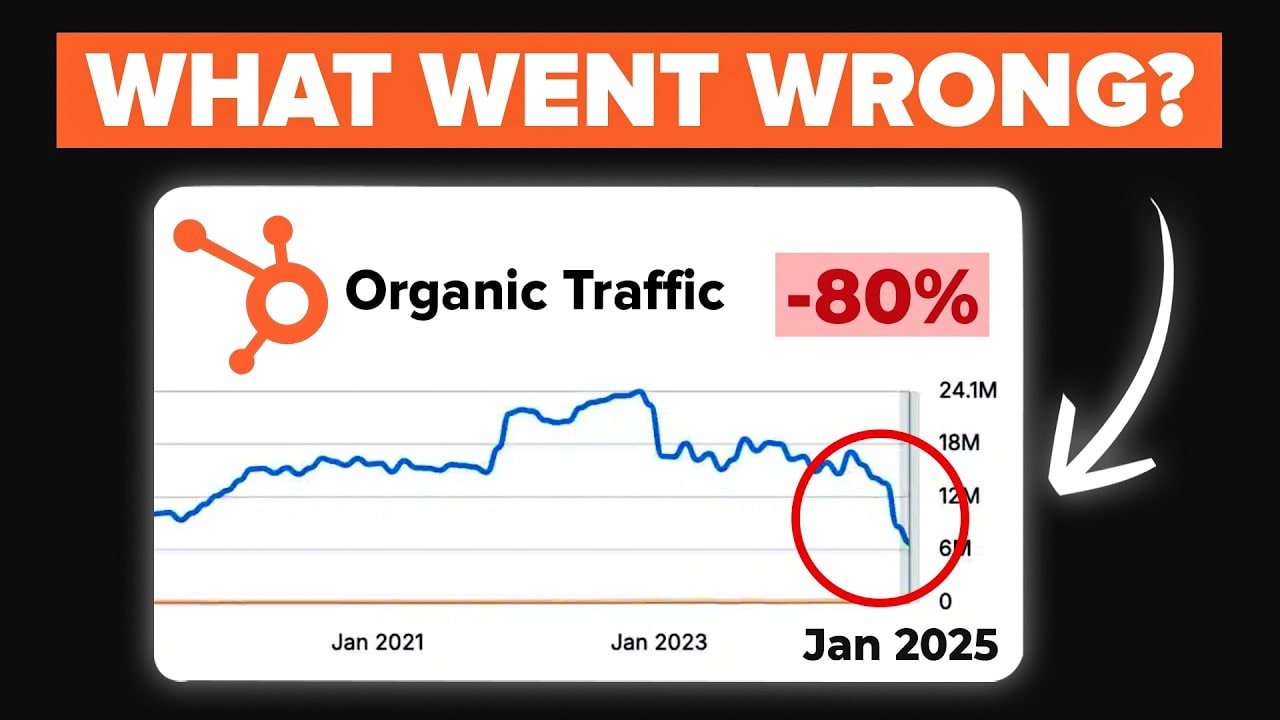
Image credit: Screenshot from "HubSpot LOST 80% of their SEO traffic: Is it bad?" by Marketing School – Daily Marketing Tips on YouTube (https://www.youtube.com/watch?v=mHBysc4yB7U).
Then December 2024 came. One month. Traffic dropped from thirteen and a half million to eight and a half million on the blog alone. By January 2025, Ahrefs had the number below two million. A site with an eighty-one domain authority score and a hundred and twenty million backlinks had lost three-quarters of its search visibility. The blog that helped teach modern B2B marketing how to do inbound was ranking top-three for thirty thousand keywords where it had once ranked top-three for a hundred and thirty-eight thousand.
The community blamed resignation letter templates. Famous quotes roundups. Posts about how to make a shrug emoji. If you weren't watching SEO Twitter in 2019 when that post became a kind of dark joke about traffic-first content, that detail probably means nothing to you, but inside this industry it meant everything. HubSpot had ranked for searches with zero relationship to CRM software, marketing platforms, or anything a buyer would type before eventually becoming a HubSpot customer. For years, those pages ranked because Google assigned relevance at the page level and domain authority lifted everything. When Helpful Content started operating at a site level, all that topical drift had a bill attached.
HubSpot's own explanation, when it came, acknowledged the machine while reframing the outcome. They said they were never chasing traffic for its own sake. That everything was measured against LTV and CAC, that AI had made breadth insufficient as a competitive advantage, that transactional keywords and LLM visibility were compensating for the losses. Every one of those statements is probably true. And none of them are the lesson for the person running a roofing company in New Jersey or a legal services firm in South Delhi who got sold the same content playbook at a fraction of the scale and budget.
I've sat with clients in both markets who had agency reports showing session growth quarter after quarter while the actual business had not converted a single organic visitor into revenue in months. The reports looked like success. The Search Console data, when we dug into it, told a different story: pages ranking for everything except anything close to what the client sold. A manufacturing business in Karachi with product-unrelated blog posts that ranked, drove traffic, and did absolutely nothing else.
Here is where the standard take on HubSpot gets it wrong: the content itself was not the problem. The problem was what the metric was standing in for. Session volume as a proxy for content health. Third-party traffic estimates treated as ground truth. Topical breadth sold as authority. The industry helped build that consensus, and December 2024 sent the invoice.
The thing the HubSpot explanation doesn't quite say directly: they had a mismatch between what drove traffic and what drove revenue for years, and they called it a strategy. When Google stopped rewarding coverage and started rewarding conviction, the gap between those two things became the size of the cliff in their analytics.
In 2022, I was working with a SaaS startup that had followed the playbook almost perfectly: consistent publishing schedule, clean backlink profile, reasonable technical health. I expected their traffic to hold through a core update because the domain metrics were solid. It didn't. The content had no real connection to the product or the buyer. We had built something popular and invisible at the same time, and by the time we figured that out, we were already explaining a cliff to a client who had stopped responding to emails.
If you're rebuilding now, or deciding whether to prune or redirect or just stop publishing, here's what I know from having sat with that kind of wreckage more than once: Google has never rewarded coverage. It rewards conviction. Build around the thing you actually know, let everything else go. Because one morning you will open your analytics and discover that Google already decided what your site is about, and you'd rather be the one who made that call first.

Waleed Qamar holds a BSc in Computer Science from Purdue University and has spent the years since turning that technical foundation into something the curriculum never covered: figuring out why websites rank, why they fall, and why most businesses never find out until it is too late.
Pakistan-born and based between the United States and South Asia, he has managed search visibility for e-commerce stores, local service businesses, and SaaS startups across two continents. He started in SEO when guest posting still worked, survived the Penguin update, and has rebuilt client sites from scratch after algorithm hits more than once.
He has watched good businesses get sold packages that looked like progress and delivered nothing lasting. He has also seen the right approach quietly double a site’s traffic without a single press release about it.
His writing on SEO By Highsoftware99 covers Google algorithm updates, autocomplete optimization, semantic SEO structure, and the widening gap between what agencies promise and what Google actually rewards in 2026.
He knows what a traffic cliff looks like in Search Console on the morning you discover it.