

*By Waleed Qamar | SEO By Highsoftware99*
—
The message came through on a Tuesday. A client, forwarding a LinkedIn post, three fire emojis, a caption that said "we need to talk." The post claimed researchers had proven Google can now identify AI-generated content with 94 percent accuracy, and the SEO industry had thirty-six hours to figure out what to do about it.
I read the study. The attribution does not check out. The paper lists two authors from the Computer Science department at Southern Methodist University in Dallas. Not Washington. The 94 percent figure is real. Everything the SEO community built on top of it is not.
Here is what the research actually found. The paper tested whether AI models could recognize their own output when shown a mix of human-written and AI-generated text. Google's Bard model was the best at it, correctly identifying its own generated text 94 percent of the time. That is a finding about AI self-detection. It is not a finding about Google Search. It is not a finding about SpamBrain. It has no direct bearing on whether publishing AI-assisted content on your website will cause your rankings to drop. The study was asking a different question entirely, and the headline that traveled through the SEO industry stripped out the part that made the number meaningful.
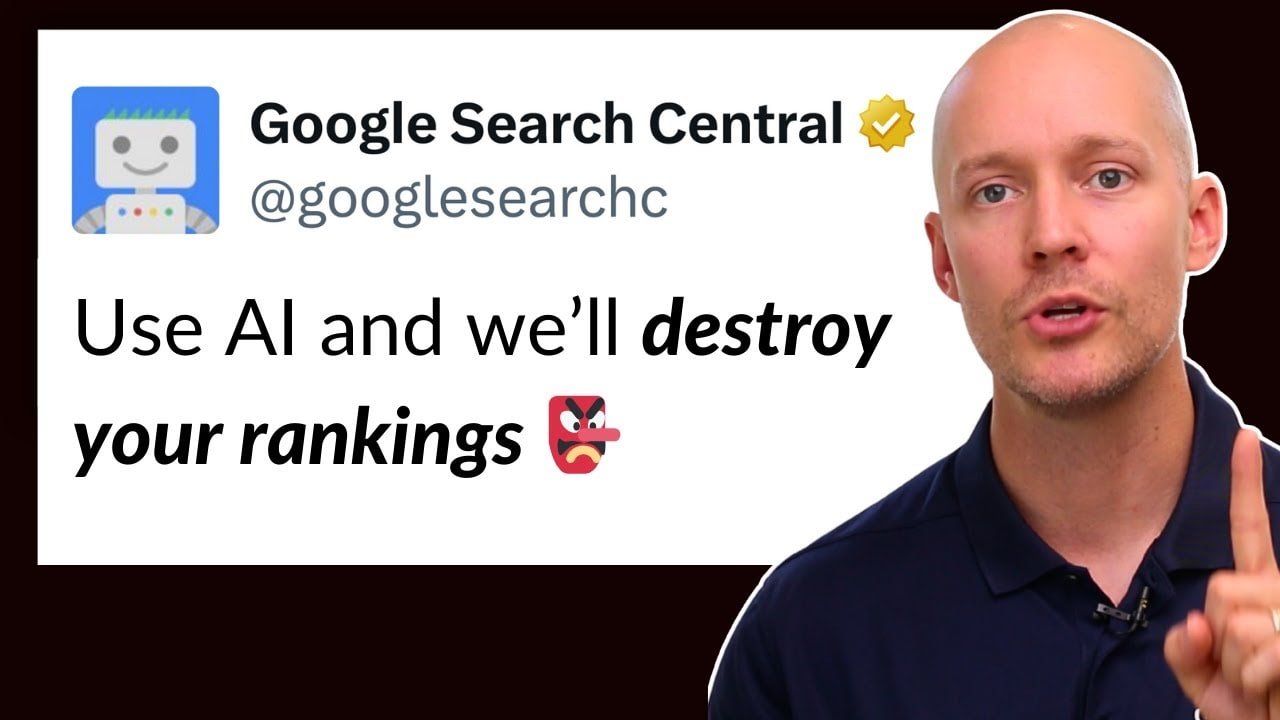
Image credit: Screenshot from "Does Google Penalize AI Content? New SEO Case Study (2026)" by Nathan Gotch on YouTube (https://www.youtube.com/watch?v=WAXmw1ImBj4).
This matters because the conversation that followed was built on a misread. Agencies started offering AI content audits. Threads appeared about "Google's new 94 percent detection layer." Business owners sent their content writers long anxious emails. A genuine piece of academic research about model self-awareness became, in the span of a news cycle, a compliance problem that needed a solution to be purchased.
The actual picture of how Google handles AI content is more specific and more honest than the version that circulates on LinkedIn. SynthID, Google's watermarking system developed at DeepMind, embeds an invisible machine-readable signal into content generated by Gemini. Over ten billion pieces of content carry that watermark as of early 2026. The system works well for what it does, which is identifying Gemini-generated content where the watermark is still intact. Run that content through a different model, translate it and back, or make substantial edits, and the signal degrades or disappears. SynthID is not a universal AI detector. It is a provenance tool for Google's own outputs.
SpamBrain is the system that actually governs what happens to AI content at ranking scale, and it does not work the way the "94 percent detection" framing implies. SpamBrain does not scan a page and declare it AI-generated. It detects quality signals and policy violations: scaled content abuse, thin pages with no original perspective, doorway structures, crawl patterns inconsistent with human publishing workflows. A page written by a person with no useful information fails the same tests as a page generated by a model with no useful information. The detection is not of origin. It is of value.
Last year, working with a health information publisher, I made a call I expected an update to undo. The site used AI drafts extensively, reviewed and edited by a staff writer with clinical experience, citations checked, original case examples added. Traffic held through the August 2025 spam update, held through December, held through March 2026. A different client, no AI involved at all, traditional writing process, thin content produced at volume by freelancers paid by the word, got hit in March 2025 and has never fully recovered. The difference had nothing to do with whether Google could identify the origin. It had everything to do with what the content did for the person who arrived.
The reason "can Google detect AI?" became the industry's central anxiety is that it reframes a quality problem as a compliance problem. A compliance problem is manageable. You check the box, you pass the audit, you move on. A quality problem requires a judgment call on every piece of content you publish, and judgment calls cannot be delegated to a policy document or a detection score.
Google does not need 94 percent accuracy at identifying AI-generated text to handle the problem the study was actually examining. It has something more consequential: improving accuracy at identifying whether content serves the person who searched for it. SpamBrain's spam detection has improved 500 percent since 2022 according to Google's own webspam reports. Quality Raters have been explicitly evaluating whether AI content shows human oversight since April 2025. The March 2026 Core Update tightened EEAT evaluation across every competitive query category, not just health and finance.
Every client who ever asked me whether Google would know their content was AI-generated was asking the wrong question. The right question was whether the person who lands on the page will find what they came for. Google has always been trying to answer that question. It is just getting much better at it.

Waleed Qamar holds a BSc in Computer Science from Purdue University and has spent the years since turning that technical foundation into something the curriculum never covered: figuring out why websites rank, why they fall, and why most businesses never find out until it is too late.
Pakistan-born and based between the United States and South Asia, he has managed search visibility for e-commerce stores, local service businesses, and SaaS startups across two continents. He started in SEO when guest posting still worked, survived the Penguin update, and has rebuilt client sites from scratch after algorithm hits more than once.
He has watched good businesses get sold packages that looked like progress and delivered nothing lasting. He has also seen the right approach quietly double a site’s traffic without a single press release about it.
His writing on SEO By Highsoftware99 covers Google algorithm updates, autocomplete optimization, semantic SEO structure, and the widening gap between what agencies promise and what Google actually rewards in 2026.
He knows what a traffic cliff looks like in Search Console on the morning you discover it.