

The number that broke the conversation was 2.3 percent.
Position one, desktop and mobile, fourteen months holding. The keyword pulled 8,400 impressions a month in Search Console. Good conversion rate when people landed. Two point three percent of them actually clicked. I'd been watching the CTR slide since the previous quarter but hadn't pinned the timing until I lined up the AI Overview rollout dates against the performance data. Five months. 6.1 percent to 2.3 percent. The featured snippet my client had earned was still sitting there beneath the blue box. Google just stopped needing people to use it.
Here's what bothers me about how people are talking about this. The zero-click numbers being quoted everywhere are being stripped of the context that makes them mean anything. When research showed that a majority of Google searches end without a click, a lot of commentary treated it like a new revelation. It wasn't. That pattern has been building since at least 2019, accelerating through every SERP feature Google added: featured snippets, knowledge panels, local packs, People Also Ask, rich results. Google has been building a wall between the searcher and the publisher for years. What AI Overviews did was not create the problem. They eliminated the buffer that had let publishers survive by winning featured snippets and still capturing a fraction of the click-through.
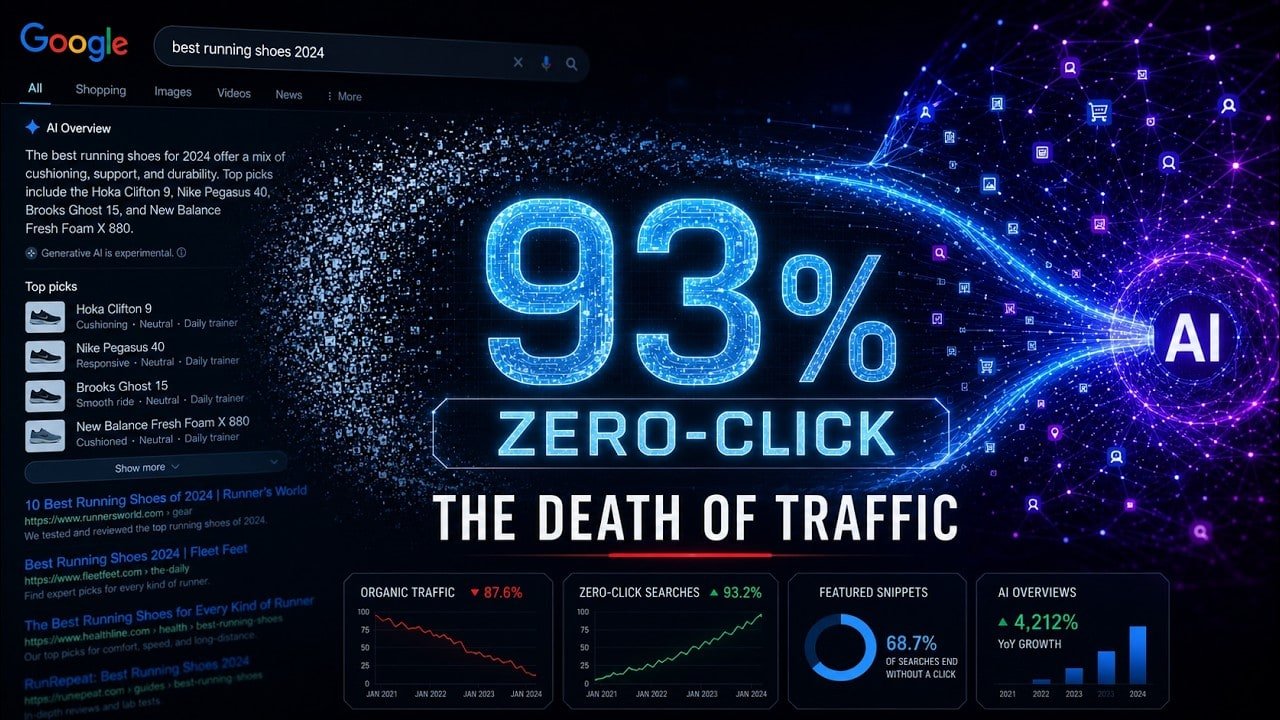
Image credit: Screenshot from "2026 Zero-Click Crisis: How SEO Experts Survive Google’s AI Update" by ctrlplusdesign on YouTube (https://www.youtube.com/watch?v=9lWYvRopnJk).
The specific number everyone keeps misquoting is the aggregate zero-click figure. That aggregate includes navigational searches. Someone typing a brand name directly into Google to reach their own site counts as a zero-click search in the data. That person was never going to click an organic result. They were using the search bar as an address bar. Pulling navigational queries out of the pool changes the picture considerably, but most of the commentary doesn't, because the headline number is more alarming and alarming travels faster than nuance.
What the aggregate obscures is what's happening to informational queries in non-branded, non-navigational categories. That's where the damage is concentrated. A client in home services had built genuine topical depth. Not keyword stuffing, actual useful content, structured with internal linking that developed entity signals around their core service categories. They ranked well. When AI Overviews started appearing consistently on their strongest informational keywords, their organic sessions from non-branded informational queries dropped 43 percent in three months. Their branded traffic rose slightly because other channels were building name recognition in parallel. The overall organic number looked less severe than it was. I almost missed the scale of it until I segmented by query type.
I also got something wrong in how I'd been advising on this, and I want to say it clearly because the same mistake is showing up in recommendations circulating right now. I believed schema markup and structured data would offer more protection than they did. The reasoning held up: give Google clean structured signals, win the featured snippet, maintain some attribution even when an AI Overview appears above it. That isn't what happened. The AI Overview pulls from multiple sources, attribution is inconsistent, and being the source Google trained on for a particular answer doesn't reliably produce the click you might expect from holding position one. I put serious technical work into a site on that basis and had to revise my position on it while watching the data in real time.
What does work is content built around transactional and commercial intent that requires specificity the AI Overview structurally cannot flatten. Comparisons requiring genuine judgment between options that have changed since Google last indexed them. Local content with current, verifiable signals tied to actual business operations. Queries where the searcher needs a decision that depends on live pricing, real availability, or individual circumstances no generated summary can resolve without the searcher making contact with someone who actually knows the answer. Google cannot synthesize that. It knows it can't. And because it can't, it doesn't intercept the click on those queries the way it does on informational ones.
The businesses that hold traffic through this are not the ones running defensive audits as though zero-click is a technical problem with a patch. It is a content architecture decision, and it has to be made at the page level: is this page answering a question Google now answers for free, or is this page something a searcher genuinely needs to reach because Google cannot get them there without it. If you cannot answer that clearly for every important page on your site, that is where your SEO budget should go. Not link building, not another schema refresh, not an AI content calendar. The audit that matters right now is the one that tells you which pages still have a reason to exist.

Waleed Qamar holds a BSc in Computer Science from Purdue University and has spent the years since turning that technical foundation into something the curriculum never covered: figuring out why websites rank, why they fall, and why most businesses never find out until it is too late.
Pakistan-born and based between the United States and South Asia, he has managed search visibility for e-commerce stores, local service businesses, and SaaS startups across two continents. He started in SEO when guest posting still worked, survived the Penguin update, and has rebuilt client sites from scratch after algorithm hits more than once.
He has watched good businesses get sold packages that looked like progress and delivered nothing lasting. He has also seen the right approach quietly double a site’s traffic without a single press release about it.
His writing on SEO By Highsoftware99 covers Google algorithm updates, autocomplete optimization, semantic SEO structure, and the widening gap between what agencies promise and what Google actually rewards in 2026.
He knows what a traffic cliff looks like in Search Console on the morning you discover it.