

Shopify is not bad for SEO. The platform handles 80% of technical SEO automatically and thousands of Shopify stores rank in top positions for competitive keywords. Real case studies show stores achieving 1,900% organic traffic growth on Shopify through proper optimization. The platform has 6 structural limitations that suppress rankings when left unresolved.
Is Shopify Bad for SEO?
Google Search documentation covers the official details in Creating helpful, reliable, people-first content.
The platform does not cause the damage. The lack of optimisation does. Shopify provides a strong ecommerce SEO foundation, but stores relying entirely on default settings will eventually hit structural SEO limitations as they scale.
Shopify powers 4.6 million live websites as of 2025. That scale shows that Shopify is widely deployed in search-sensitive businesses, and many merchants rely on organic traffic successfully. The platform's SEO performance divides into 2 categories: what it handles automatically and what requires manual intervention.
Top of the Funnel Keywords: Definition, 5 Types, Examples, and SEO Strategy
Search Engine Reputation Management (SERM): Definition, 6 Strategies, and How It Works
What Are the 5 Built-In SEO Strengths of Shopify?
Shopify includes 5 built-in SEO features: mobile-optimized responsive themes, automatic SSL certificate installation, automatic XML sitemap generation, canonical tag implementation, and global CDN hosting for fast page delivery worldwide.
Built-In Feature | SEO Benefit | Manual Action Required SSL certificate | HTTPS across all pages | None XML sitemap | Auto-generated at /sitemap.xml | Submit to Search Console Canonical tags | Reduces duplicate content | Review for accuracy Mobile-responsive themes | Supports mobile-first indexing | Choose a speed-optimized theme Global CDN | Reduces page load time | Compress and convert images to WebP
What Are the 6 SEO Limitations of Shopify?
Shopify has 4 documented structural SEO limitations: duplicate URLs from product variants, URL structure inflexibility with forced /collections/, /products/, and /blogs/ paths, default theme performance that does not always meet Core Web Vitals standards, and schema markup conflicts when multiple apps inject competing structured data simultaneously.
The full list of 6 Shopify SEO limitations:
- Duplicate content from products appearing in multiple collection URLs
- Rigid URL structure with forced subfolder paths
- Duplicate URLs created by product variants
- Limited blogging capabilities compared to WordPress
- Schema markup requires apps or custom JSON-LD for advanced implementation
- App accumulation degrades Core Web Vitals and introduces conflicting scripts
What Is Shopify's Biggest SEO Problem?
The most critical issue is that products accessible via multiple collection URLs create duplicate content by default, diluting link equity and confusing search engines about which page to rank. Many merchants assume ecommerce SEO is fully handled by the platform.
A product accessible through 3 collections generates 3 indexed URLs. Examples include /collections/mens/products/blue-shirt, /collections/sale/products/blue-shirt, and /collections/new-arrivals/products/blue-shirt. All 3 display identical content.
How Do You Fix Duplicate Content on Shopify?
Fix duplicate product URLs immediately by removing the "within: collection" filter from theme templates. This single change eliminates the platform's most common SEO problem.
Follow these 4 steps to resolve Shopify duplicate content:
- Open the Shopify theme code editor and locate the product URL template file
- Remove the collection context from product URL output so all products resolve to /products/ only
- Confirm canonical tags on all product pages point to the /products/ version of the URL
- Run a site crawl using Screaming Frog to verify no duplicate product URLs remain indexed
How Do Product Variant URLs Create Duplicate Content in Shopify?
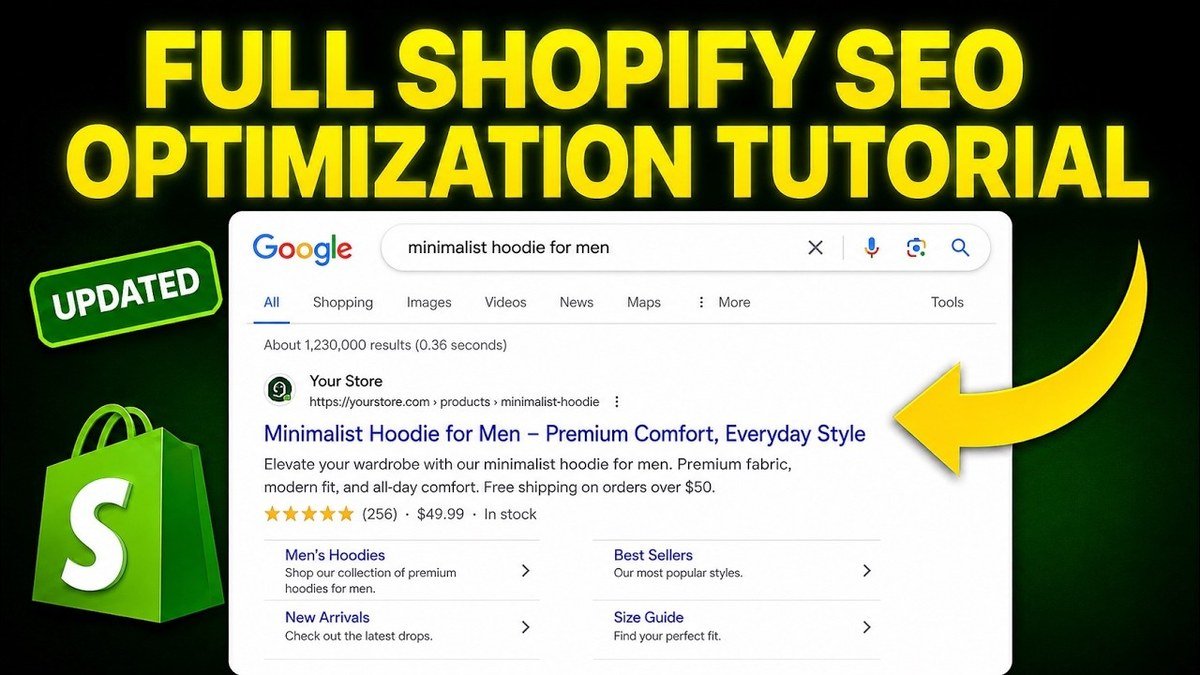
Shopify creates separate URLs for product variants by default. Without canonical tags correctly applied, this creates duplicate content at scale across large catalogues. A product with 5 color variants generates 5 indexable URLs with near-identical content. Shopify automatically generates canonical tags to prevent duplicate content issues from products appearing in multiple collections or having variant pages. Manual intervention may be needed when syndicating content to marketplaces or social platforms.
How Does Shopify's URL Structure Affect SEO?
The most common friction points are duplicate URL paths, limited control over canonicals for collection pages, the fixed /blogs/ URL prefix, and the fact that SEO quality can degrade when themes accumulate app scripts. The complaint is rarely "Shopify can't rank." It is more often "Shopify will not let me structure or mark up content exactly how I want."
Shopify enforces 3 fixed URL subfolder structures:
- /products/ for all product pages
- /collections/ for all category pages
- /blogs/ for all blog content
Can You Change Shopify's URL Structure to Remove These Subfolders?
Shopify does not allow removal of /products/, /collections/, or /blogs/ from URLs. Shopify's main limitations include forced URL structures with /products/ and /collections/ paths that cannot be customized. This is rarely a ranking problem in practice, but it does mean you cannot customise URL paths the way you can on other platforms. Compensate for fixed URL structure through strong internal linking, descriptive URL handles, and breadcrumb schema markup.
How Does Shopify's Blog Compare to WordPress for SEO?
Shopify does offer blogging capabilities, but its features are basic compared to platforms like WordPress. Shopify's blog editor lacks advanced tools for SEO, such as in-depth meta tag optimization or support for SEO plugins like Yoast. This limitation makes it harder for merchants to leverage content marketing as part of their SEO strategy.
For serious content marketing, consider the hybrid approach with WordPress on a subdomain. The only Shopify SEO fixes that require coding knowledge are advanced duplicate content solutions and custom schema implementations. These can be handled through apps or by hiring a developer for one-time fixes.
What Are the Best Shopify SEO Apps for Fixing Platform Limitations?
Shopify can and will create duplicate content when users apply filters or browse paginated collections, potentially creating tens, sometimes hundreds, of essentially duplicate pages. Filtered pages generate dynamic URLs that Google may index as duplicate content. It is important to implement canonical tags to direct search engines to the main product or category page.
4 Shopify SEO apps address the platform's structural limitations:
- Plug In SEO: audits for missing meta descriptions, broken links, and missing alt text. Free version available.
- SEO Manager: handles meta tag templates at scale, JSON-LD schema customization, and 404 monitoring
- Smart SEO: automates meta tags, JSON-LD structured data, and image alt text across the full catalogue
- Schema App: removes conflicting theme-generated microdata and replaces it with clean JSON-LD
Stores that stack multiple apps for reviews, SEO, speed, and structured data frequently end up with conflicting scripts, duplicate schema markup, and bloated page load times. Multiple apps adding schema simultaneously cause validation errors. Limit active SEO apps to 2 at a time and audit installed apps quarterly to remove unused scripts.
Does Shopify Rank as Well as WordPress for SEO?
Shopify stores can rank equally well as WordPress sites. While WordPress offers more customization flexibility, Shopify provides performance advantages including 1.8x faster loading speeds on average. Google ranks pages based on relevance, content quality, and authority rather than the platform powering them.
Merchants achieving strong organic growth on Shopify share 5 common characteristics: they conduct thorough keyword research, they customize title tags and meta descriptions, they write detailed product descriptions, they build strategic internal linking, and they invest meaningfully in earning quality backlinks. These fundamentals produce results regardless of platform architecture.

Waleed Qamar holds a BSc in Computer Science from Purdue University and has spent the years since turning that technical foundation into something the curriculum never covered: figuring out why websites rank, why they fall, and why most businesses never find out until it is too late.
Pakistan-born and based between the United States and South Asia, he has managed search visibility for e-commerce stores, local service businesses, and SaaS startups across two continents. He started in SEO when guest posting still worked, survived the Penguin update, and has rebuilt client sites from scratch after algorithm hits more than once.
He has watched good businesses get sold packages that looked like progress and delivered nothing lasting. He has also seen the right approach quietly double a site’s traffic without a single press release about it.
His writing on SEO By Highsoftware99 covers Google algorithm updates, autocomplete optimization, semantic SEO structure, and the widening gap between what agencies promise and what Google actually rewards in 2026.
He knows what a traffic cliff looks like in Search Console on the morning you discover it.