

By Waleed Qamar | SEO By Highsoftware99
The rankings shifted before most people finished reading the keynote announcement.
Not all rankings. Not even most of them. But enough that by the morning after Google I/O 2026, three separate messages from clients had landed asking why their position tracking looked strange. Two were asking about gains they had not expected. One was asking about a drop on a page that had been stable for eleven months. All three changes had happened within a six-hour window that corresponded exactly with when Google confirmed Gemini 3.5 Flash was live inside Search.
This is the part the upgrade posts are not explaining clearly enough. Google did not update a ranking algorithm. It replaced the underlying model that interprets queries and evaluates document relevance across the AI-driven systems that now handle the majority of search interactions. That is a different category of change. Algorithm updates adjust weights within a model that already exists. A model swap changes what the model considers in the first place: how it reads semantic relationships between entities, how confidently it matches a document to a query intent, how much it trusts co-citation patterns versus structural markup, and how it calibrates the threshold between a page that ranks and a page that gets surfaced in an answer.
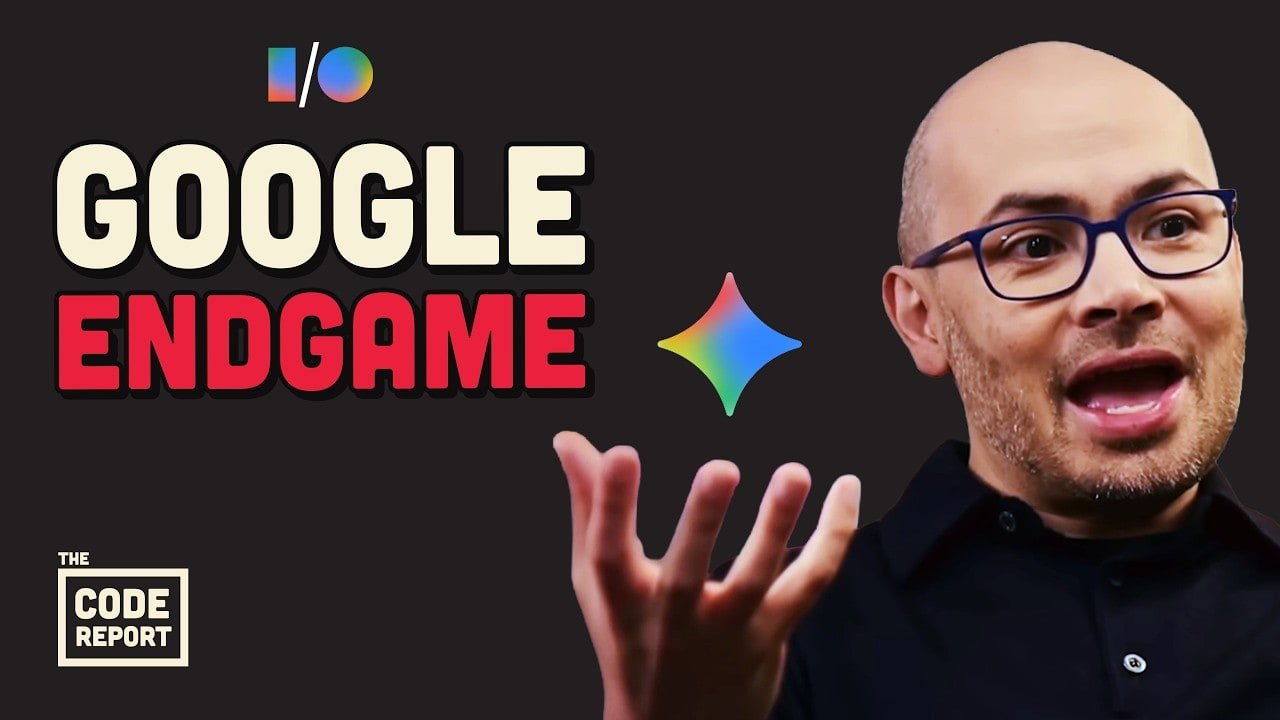
Image credit: Screenshot from "Google’s AI endgame is here… everything you missed at I/O 2026" by Fireship on YouTube (https://www.youtube.com/watch?v=9OQ5vaYbGV0).
Gemini 3.5 Flash processes multi-step reasoning differently from the model it replaced. Specifically, it handles what Google's documentation now calls "intent decomposition" at a finer granularity. A query like "best accounting software for a freelance designer in New York" gets split into constituent intents and evaluated against pages that satisfy combinations of those intents, not just pages that contain the keywords. That process existed before. The Flash architecture runs it faster and, more relevantly for ranking purposes, with higher confidence thresholds before it commits to a result. Pages that were ranking adequately under the previous model's confidence tolerance are now being re-evaluated against a stricter standard.
The client drop I mentioned was a local service page that had been doing everything correctly for nearly a year. Proper schema, clean internal linking, solid topic coverage, legitimate local citations. Under the previous model it held position four for its primary query cluster. Under Flash it dropped to eleven within forty-eight hours. When I looked at what had moved above it, three of the pages had almost identical schema, shorter content, and weaker link profiles by every traditional measure. What they had that my client's page lacked was a tighter semantic match between their page's primary entity and the sub-intents Flash was now decomposing the query into. The page that ranked first used the exact phrase structure that matched the intent decomposition output. It was not a better page by any measure I would have used to predict rankings the week before. It was a better-matched page by a measure that had just changed.
The conventional fix for a model transition like this is to audit your content against the new model's apparent preferences and realign. That is the right instinct applied to the wrong layer. Chasing the signal patterns of a new model produces content tuned for a snapshot of that model's behavior during its first weeks of live deployment. Google will iterate on Flash. The patterns visible in June 2026 will not be the patterns that matter in October 2026. What the transition actually revealed, for any site that watched carefully, was which pages had surface-level relevance and which had structural relevance. Surface-level pages held under the old model because the confidence thresholds were more forgiving. Flash exposed the gap.
There is advice circulating right now telling businesses to produce content specifically formatted to match how Gemini 3.5 Flash structures its answers. Some of it is not wrong as a tactical matter. But businesses following it without understanding why it works will be in the same position in twelve months when the next iteration ships and the format preferences shift again. Optimization without understanding is a faster way to get surprised.
What I took from watching those three client accounts over the forty-eight hours after the model swap was something I had suspected but not confirmed at scale: Flash is more sensitive to entity relationship depth than the previous model, and less sensitive to keyword density signals that still show up in crawl reports as meaningful indicators. Pages with strong entity co-occurrence in external reference sources moved up. Pages that were keyword-dense but entity-thin moved down. The gap between those two categories is exactly what most small business SEO packages are not building for, because entity relationship work is harder to put in a monthly report than a keyword ranking table.
If your pages dropped after the Flash transition and you cannot identify a single external reference source that confirms your primary business entity in direct relation to the services it actually provides, the problem is not on the page, and no volume of content revisions is going to reach the layer where the ranking decision is now being made.

Waleed Qamar holds a BSc in Computer Science from Purdue University and has spent the years since turning that technical foundation into something the curriculum never covered: figuring out why websites rank, why they fall, and why most businesses never find out until it is too late.
Pakistan-born and based between the United States and South Asia, he has managed search visibility for e-commerce stores, local service businesses, and SaaS startups across two continents. He started in SEO when guest posting still worked, survived the Penguin update, and has rebuilt client sites from scratch after algorithm hits more than once.
He has watched good businesses get sold packages that looked like progress and delivered nothing lasting. He has also seen the right approach quietly double a site’s traffic without a single press release about it.
His writing on SEO By Highsoftware99 covers Google algorithm updates, autocomplete optimization, semantic SEO structure, and the widening gap between what agencies promise and what Google actually rewards in 2026.
He knows what a traffic cliff looks like in Search Console on the morning you discover it.