

*By Waleed Qamar | SEO By Highsoftware99*
—
The ranking was still there. Position one, highlighted in green in the monthly report, the way agencies always present it. She'd held that spot for eight months. What the report left out was what her Search Console had been showing for the same period: clicks in a straight-line decline, month on month, on the exact queries she was supposedly dominating.
She asked if she'd been penalized. She hadn't. She asked if a competitor had overtaken her. Nobody had. She was ranking first. She just wasn't getting the traffic that first place used to mean.
The Penske Media Corporation lawsuit, now sitting in front of Judge Amit Mehta in Washington DC, is the first time I've seen the mechanics of that problem laid out in 108 pages with subpoenas attached.
PMC publishes Rolling Stone, Variety, Billboard, The Hollywood Reporter. Not small businesses. Established editorial teams, real domain authority, years of original reporting. And their legal complaint describes, in documented detail, the same thing I've been watching happen across far smaller budgets: Google taking the content, surfacing it at the top of results, and keeping the user exactly where they already are.
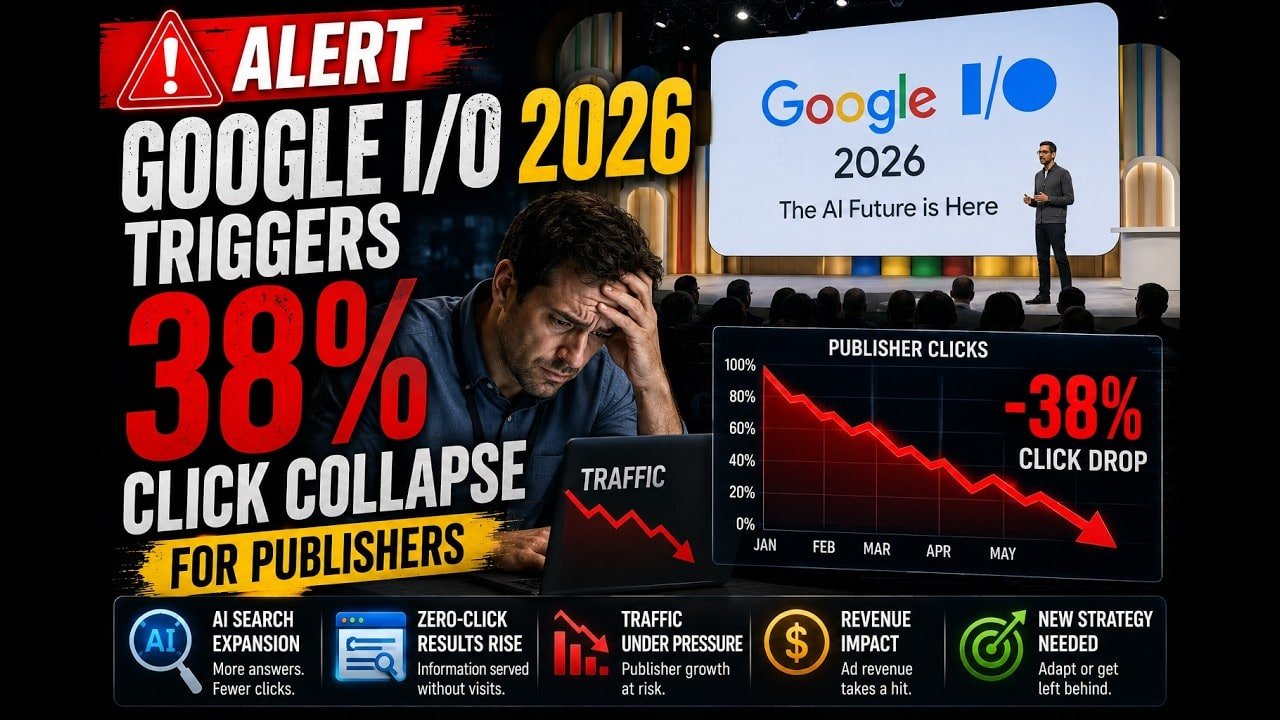
Image credit: Screenshot from "What Nobody Noticed About Google I/O’s Search Traffic Shift" by Sun BPO Solutions on YouTube (https://www.youtube.com/watch?v=7KjaYwEmAzI).
The word in the filing is "cannibalization." What that means in practice: Google's AI Overviews pull from your page, answer the user's question, and give them no reason to click. You still rank. You are just no longer the destination.
The data cited in the February 2026 opposition filing is what made me stop. Ahrefs analyzed 300,000 keywords against aggregated Search Console data. For informational queries, position one click-through rates dropped from 7.6% to 3.9% over two years. That is not an algorithm shift. It is structural. And those numbers are for pages where no AI Overview appeared. The Pew figure covers queries where one did: users clicked a traditional result 8% of the time. Not 8% fewer. 8% of all visits. PMC executives gave direct testimony to the same effect. They said they can see users reading the overview and stopping. It shows up in their own data.
Then there is what the filing calls the "Hobson's choice." Either you allow Google to use your content for AI training and AI Overviews, or you opt out of indexing entirely. There is no middle position. The filing cites Google's own guidance, then shows what traffic data looks like for publishers who have tested withholding content. The implied consequence does not need to be spelled out.
Here is where the conventional advice falls apart in ways that matter to everyone running a content site. The standard response to traffic decline used to be: fix your technical issues, improve content quality, build better links. I gave that advice. It worked, reliably, for years. It does not work when the click is gone before the user reaches the ten blue links. The audit finds nothing wrong because nothing is wrong. The page is correctly indexed, well-structured, genuinely relevant. The problem is above the page.
PMC's brands did not cut corners. Variety still has reporters. The Hollywood Reporter still covers what it covers. Their traffic declined anyway, because the contract that let the open web function is being honoured by one party and not the other.
What the lawsuit actually does for everyone else is put a number and a legal record on something that has been visible in Search Console data for over a year. When I show a client their CTR trend alongside their ranking trend, and the two lines are moving in opposite directions, I no longer have to speculate about why. There are now 108 pages, filed under oath, that describe the mechanism precisely.
Whether PMC wins will matter. But for the clients I'm talking to right now, the lawsuit is not the solution. It is confirmation. The traffic they have been losing has been going somewhere, and this filing names where.
If you are still running SEO on the assumption that your rankings are your traffic, the data in this case is the most specific evidence yet that the assumption stopped being true a while ago, and nobody told you.
Waleed Qamar holds a BSc in Computer Science from Purdue University and has spent the years since turning that technical foundation into something the curriculum never covered: figuring out why websites rank, why they fall, and why most businesses never find out until it is too late.
Pakistan-born and based between the United States and South Asia, he has managed search visibility for e-commerce stores, local service businesses, and SaaS startups across two continents. He started in SEO when guest posting still worked, survived the Penguin update, and has rebuilt client sites from scratch after algorithm hits more than once.
He has watched good businesses get sold packages that looked like progress and delivered nothing lasting. He has also seen the right approach quietly double a site’s traffic without a single press release about it.
His writing on SEO By Highsoftware99 covers Google algorithm updates, autocomplete optimization, semantic SEO structure, and the widening gap between what agencies promise and what Google actually rewards in 2026.
He knows what a traffic cliff looks like in Search Console on the morning you discover it.