

Sixty-three percent of their inbound leads came from organic search. That is the number the agency's founder told me when we spoke earlier this year. Past tense: came from.
The agency had been operating for nine years. Good work, genuine clients, the kind of shop where the people doing the work actually understood what they were doing. Their own site was the proof of concept. Forty thousand monthly visitors at peak, built almost entirely on informational SEO content. Keyword research guides, tool comparisons, concept explanations pitched at the exact level their prospective clients were searching for. Not thin content. Not spun content. Real work, done by people who knew SEO. And between September and April, 71 percent of it was gone.
What they described in their internal post-mortem, which they shared with me and a small number of other practitioners, was not a Google penalty. There was no penalty signal in Search Console. No manual action. No sudden crawl anomalies. What there was, and this is the part that the surface-level coverage of their situation keeps missing, was a query-by-query replacement of their informational content with AI Overviews. Not across the board. Specifically on the queries their traffic had always been built on: definitional, explanatory, and comparison content. The exact content type that had worked best for nine years was the exact content type that became redundant in eight months.
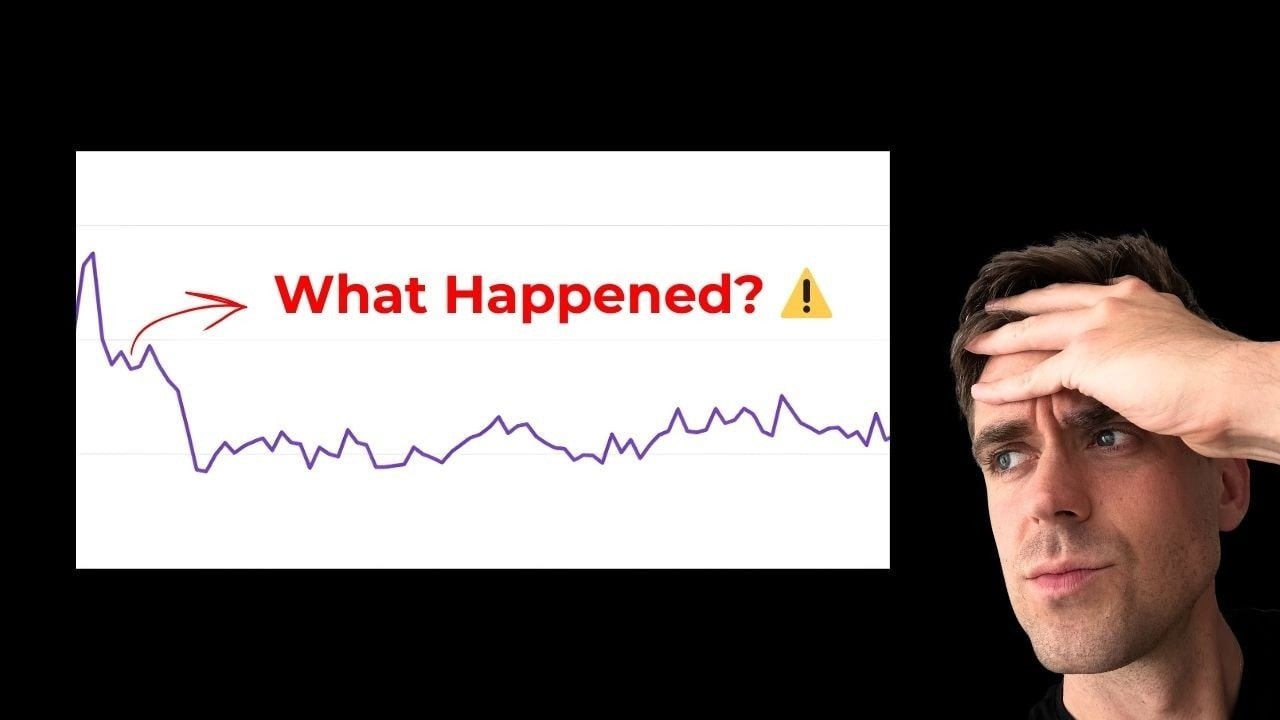
Image credit: Screenshot from "Why Your Google Traffic Dropped in 2026 (And How to Fix It)" by Keyword_com Rank Tracker on YouTube (https://www.youtube.com/watch?v=v1LhpXZdOvQ).
Here is what the agency tried when they first saw the decline. They did what the framework says to do: they improved the E-E-A-T signals on their highest-traffic pages. Added first-hand experience callouts, sharpened author credentials, updated the content with more recent data, tightened the topical coverage. The framework was correct in principle. The problem was that it was solving the wrong problem. Their pages were not losing traffic because Google doubted their expertise. They were losing traffic because Google was answering the queries their pages ranked for without needing to send a click anywhere. Improving quality signals did not change what query type the content was. It was still informational content. It was still precisely what AI Overviews were built to displace.
The domain authority dimension is the one worth sitting with. This agency had twelve years of accumulated link equity. A genuinely strong referring domain profile, the kind most of their clients would never reach. That domain authority protected them exactly as much as it protected the major publishers who reported the same pattern this year: not at all, on the query types where it mattered. Domain authority is a measure of how trusted your site is. It is not a measure of how much Google still needs your site to deliver an answer.
What they eventually understood, and this is the honest part of their honest account, was that the site had been built as a content machine for a version of search that no longer existed in their content categories. Every piece had been created to rank for a query. Almost none of it had been created to be a destination that a user needed to reach to get something unavailable from a generated summary. The content was accurate. The content was useful. The content was, by every measure the SEO industry applies to evaluate quality, good. It just answered questions. And Google stopped needing it to do that.
The rebuild they are doing now is not a content refresh. They are not updating title tags and adding schema to existing pages and calling it a recovery strategy. They are making a harder decision about which content categories they should occupy at all. Service comparisons that require current pricing knowledge and client-specific judgment. Case studies dense with outcomes specific enough that no generative system can fabricate them. Content that positions them as the source of judgment rather than the source of information. The distinction sounds philosophical until you are staring at a Search Console property where 71 percent of your sessions have stopped arriving.
The thing I keep coming back to from that conversation is what the founder said about the internal reporting they had been reviewing in the months before the cliff appeared. The rankings were holding. The impressions were high. The CTR data was showing the decline but it was being read as seasonal variation. Every metric except the one that mattered, which was whether those visits were actually happening, looked acceptable. They were measuring the right things in the wrong order. Build your dashboards around sessions and conversions before you build them around rankings and impressions, and you see the problem at the moment it starts rather than the moment it has already cost you eight months of pipeline.

Waleed Qamar holds a BSc in Computer Science from Purdue University and has spent the years since turning that technical foundation into something the curriculum never covered: figuring out why websites rank, why they fall, and why most businesses never find out until it is too late.
Pakistan-born and based between the United States and South Asia, he has managed search visibility for e-commerce stores, local service businesses, and SaaS startups across two continents. He started in SEO when guest posting still worked, survived the Penguin update, and has rebuilt client sites from scratch after algorithm hits more than once.
He has watched good businesses get sold packages that looked like progress and delivered nothing lasting. He has also seen the right approach quietly double a site’s traffic without a single press release about it.
His writing on SEO By Highsoftware99 covers Google algorithm updates, autocomplete optimization, semantic SEO structure, and the widening gap between what agencies promise and what Google actually rewards in 2026.
He knows what a traffic cliff looks like in Search Console on the morning you discover it.